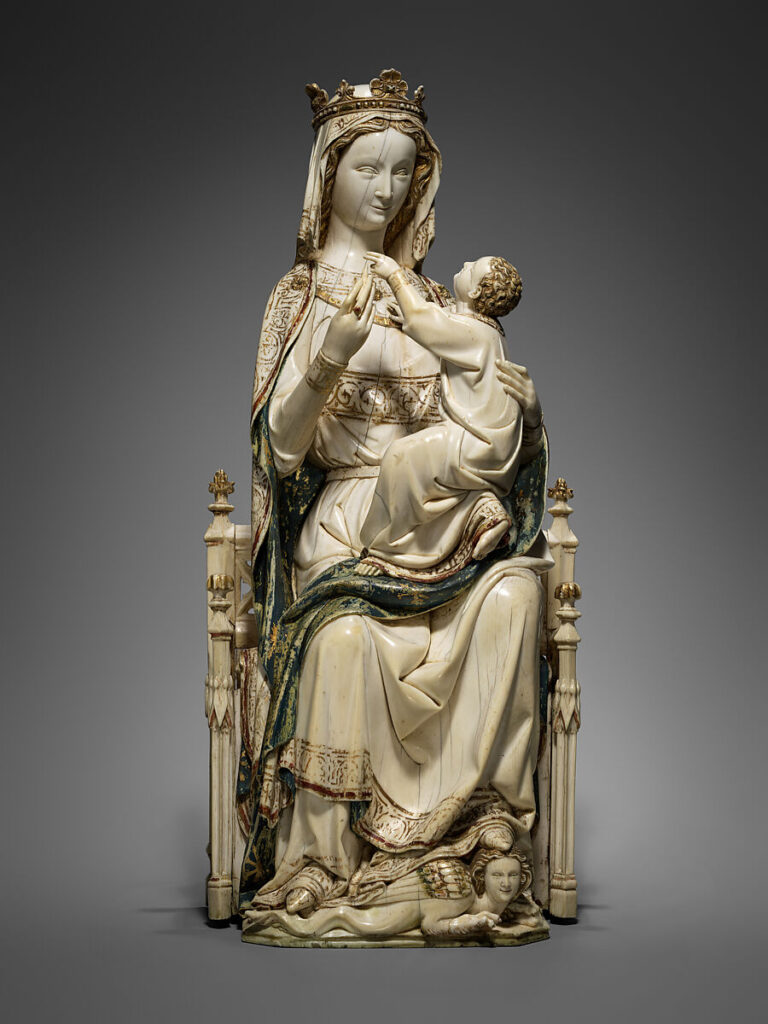
Virgin and Child ca. 1275–1300
Recently, I’ve been researching the textual history behind a particular reading of Genesis 3:15, specifically the rendering “she shall crush”, and have found it to be a fascinating area of discussion. I’ve wanted to write my thoughts on this subject for some time, and after finding unsourced claims defending a feminine reading of the text in an online forum, I tracked down the primary sources. Driven by this catalyst, this article establishes that the historical data overwhelmingly supports a feminine reading of the verse.
The verse, as translated in the NIV, reads: “And I will put enmity between you and the woman, and between your offspring and hers; he will crush your head, and you will strike his heel.”
With this text in mind, it’s important to note that the original Hebrew text of the Old Testament was written with consonants only, that is, no vowels. Vowels were added around a thousand years later by medieval Masorete scholars. This means that for much of the period in which the early church was reading and transmitting Genesis 3:15, the vowel system we now take for granted had not yet been standardized. The pronoun rendered “he” in most modern translations is spelled identically in Hebrew to the word for “she” throughout the Torah. Due to this, the reading “she” is not grammatically impossible; the gender depends entirely on the vowel pointing one applies, which in this case is a medieval decision, not an original authorial inscription. Contextually, this same pronoun appears elsewhere in the Pentateuch where it is understood to carry a feminine meaning despite its masculine spelling. The pronoun’s antecedent in Genesis 3:15 is the noun “seed,” which is grammatically masculine in Hebrew, and the verb that follows it is likewise masculine in form. This is why, with the available manuscripts that feature a formal vowel system, the word is consistently translated as “he.”
Now with this in mind, notable divergence exists across faith traditions, with some particularly in Catholic and certain traditional Latin circles preferring the reading “she shall crush,” drawn from the Latin Vulgate’s “ipsa.” With a considerable amount of debate surrounding this topic, I’ve been examining areas of evidence that shed some light on whether the “she shall crush” reading has any legitimate support in ancient manuscripts, and I’d like to share what I’ve found. In this article, I will demonstrate that the “she shall crush” reading of Genesis 3:15 is a valid reading of the text, not on the basis of Hebrew grammatical evidence, but from the collective witness of patristic writers who attest to the feminine reading across multiple centuries, languages, and traditions, establishing it as a credible interpretation rather than a mistranslation or theologically motivated invention.
First, after reading Taylor Marshall’s book The Crucified Rabbi, the author uses Josephus as a proof text for the “she shall crush” reading of the verse. Delving deeper into the source for this, Marshall seems to appeal to Josephus’s Antiquities. I found this to be not as strong as I was expecting, and would offer Dr. Mark Steven Francois’ response to this source for further clarification [1]. The same can be said for some older commentators (e.g. Cornelius a Lapide) who claimed certain Hebrew manuscripts in the Vatican library supported the feminine pronoun instead of the standard in Genesis 3:15. Another write-up contests this idea, which can be found here. [2]
Nevertheless, I believe three significant sources lend considerable support to the ancient “she shall crush” reading.
1. Philo of Alexandria (20BC – 50AD):
Some claim Philo argued that the structure of the Hebrew in Genesis 3:15 demands a feminine reading. Taylor Marshall references this idea but doesn’t footnote it, so I went digging. In Philo’s work On the Creation, section LXVII (188), Philo comments:
“And the expression, ‘He shall watch thy head, and thou shalt watch his heel,’ is, as to its language, a barbarism, but, as to the meaning which is conveyed by it, a correct expression. Why so? It ought to be expressed with respect to the woman: but the woman is not he, but she…” [3]
This is intriguing because Philo is writing in the first century, entirely independent of any Marian theological agenda, yet arrives at the same conclusion, that the feminine is the more natural reading of the passage. His observation shows an early and unbiased witness to the question.
2. Tertullian (197 AD):
A second early witness to the feminine translation, he writes:
“This also was wanting to the Christian woman, that she may add a grace to herself from the serpent! Is it thus that she will set her heel on the devil’s head, while she heaps ornaments (taken) from his head on her own neck, or on her very head?”(On the Apparel of Women, 1:6)[4]
An alternative rendering makes the allusion even more explicit:
“This would indeed crown it all: the Christian woman in need of something from the serpent to add to her grace. It is probably in this way that she is going to tread upon the serpent’s head while around her neck or even on top of her own head she carries ornaments that come from the head of the Devil!”
3. Vetus Latina (150 AD – 200 AD):
Lastly, a similar interpretation is attested to in the Vetus Latina. The following is from a Reddit user:
The Vulgate has:
Inimicitias ponam inter te et mulierem, et semen tuum et semen illius : ipsa conteret caput tuum, et tu insidiaberis calcaneo eius.
Whereas the Vetus Latina has: Et inimicitias ponam inter te et inter mulierem, et inter semen tuum et semen eius : ipsa tibi servabit caput, et tu servabis eius calcaneum.[5]
That is, where the Vulgate has: she will bruise your head, and you will ambush her [or: his] heel
The Vetus Latina has: she will watch your head, and you will watch her [or: his] heel
Contrast this to the: he will bruise your [male] head, and you [male] will bruise his heel of the Masoretic text.
The feminine interpretation of this text has been said not to be attested before the Latin Vulgate in the fourth century [6]. The three points above contrast with this claim.
Historical Exegesis Or A Mistranlation?
Continuing on, it would seem that in circles online, a claim is being made that the feminine reading in Gen 3:15 has only come about from a translation error. It is not uncommon when diving into this subject to see some argue that the translation “she shall crush thy head” is based on a copyist’s error of the Latin Vulgate after Jerome faithfully translated the Hebrew into Latin as “he will crush your head.” See the following:
Excerpt from The Pulpit Commentary:
“…and the seed of the woman signifying those whose character and life should be of an opposite description, and in particular the Lord Jesus Christ, who is styled by preeminence “the Seed” (Galatians 3:16, 19), and who came “to destroy the works of the devil” (Hebrews 2:4; 1 John 3:8). This we learn from the words which follow, and which, not obscurely, point to a seed which should be individual and personal. It – or he; αὐτος (LXX.); not ipsa (Vulgate, Augustine, Ambrose, Gregory the Great; later Romish interpreters understanding the Virgin) – shall bruise.” [7]
And, from the Cambridge Bible for Schools and Colleges:
“The Vulgate ipsa conteret caput tuum is noticeable. By an error, it rendered the Heb. masc. pronoun (“he” = LXX αὐτός) by the feminine pronoun “ipsa,” ascribing to the woman herself, not to her seed, the crushing of the serpent’s head. The feminine pronoun has given rise to some singular instances of exegesis in honour of the Blessed Virgin Mary.” (Ibid)
In hopes of addressing this, I will offer a short response below.
To suggest that independent witnesses across a multitude of languages repeated the same translation error and independently arrived at identical interpretations is effectively impossible. For the mistranslation hypothesis to hold, one must explain how a single copyist’s error propagated simultaneously across entirely independent scribal, linguistic, and cultural traditions, spanning many distances (Spain, France, Italy, North Africa, Jeruselum, England, and the Syrian-Turkish border), over more than a thousand years, and account for why every one of the following authors, arrived at the same feminine reading of Genesis 3:15. Below are a compiled list of authors who render the femine interpretation. The first four predate Jerome’s Vulgate:
1. Ephram (307 AD) Syriac. A witness entirely independent of the Latin manuscript tradition writes “The serpent which made him fall, saw to what height he was raised:—he crushed it because it deceived him; the feet of Eve trod it down,—which had sent venom into her ears.” (Hymns on the Nativity, Hymn XIV, Stanza 16 )[8]
And
“Of him the Lord said, that he had fallen from Heaven.— The Abhorred One had exalted himself; from his uplifting he has fallen. The foot of Mary has trod him down, who bruised Eve with his heel.” (Hymns on the Nativity of Christ in the Flesh, Hymn XV, Stanza 31)[9].
2. Augustine (388 or 389 AD ): “I will place enmity between you and the woman and between your seed and her seed. She will watch for your head, and you will watch for her heel” (On Genesis against the Manichees, Book 2, Chapter 1). [10]
3. St. Prudentius (405 AD): “Now we see the Serpent lewd ‘Neath the woman’s heel downtrod: Whence there sprang the deadly feud, Strife for ages unsubdued, ‘Twixt mankind and foe of God. Yet God’s mother, Maid adored, Robbed sin’s poison of its bane, And the Snake, his green coils lowered, Writhing on the sod, outpoured Harmless now his venom’s stain.” (CATHEMERINON Hymnus ante Cibum (Hymn Before Meat )). [11]
4. Ambrose (391-394AD): “But to return to the point, that God judged that evil was to be held in check for a time rather than to be destroyed, He says to the serpent, “I will put enmities between you and the woman, and between your seed and the seed of the woman. She shall watch for your head and you for her heel.“20 Where there are enmities, there are discord and the desire to do harm; where there is the desire to do harm, there evil is established.” (Flight from the World 7.43.) [12]
5. Claudius Marius Victor (420-430AD): “and I shall specially kindle the hatred of the human race against your entire kind, steeped in cruel venom — I shall command that you be always feared and, even more, killed. As for her whom you rejoice to have subdued by your first deception, living lower than her feet and coiled upon your breast, you shall be such a snare for the sole of her feet that, trembling with fear, she shall crush your head with her heel.” [13]. (Victorius, Claudius Marius. Alethia 490-496).
6. Hesyvhimus of Jerusalem (450 AD) Greek: “Behold the Virgin! Which one? The distinguished of all women, the elect of all virgins, the excellent ornament of our nature, the glory of our race, the one who freed Eve from shame and Adam from the threat, and decapitated the boldness of the dragon.47”. (Migne, J.-P. Patrologiae Cursus Completus: Series Latina. Vol. 93, Garnier Fratres, 1862). [14]
7. Avictus of Vienna (495-517AD): “Then, when she had finished, God’s sentence made clear His final decree, and with His first words He branded the snake guilty. “You, snake, by whose deceit the woman sinned and herself delivered up her husband as a companion in error, for the crime of each you are responsible and will pay the penalty for what each did. You shall not stand erect in head and body, but prone, you shall wheel your cunning heart across the earth, and so that your sinuous coils may run trembling and in flight, not walking but slipping along with twisting spasms, self will creep behind self and living chains will bind your wriggling form. Then, in return for the food you urged upon these poor creatures, eating earth, you will enjoy an empty repast, and for those months I designate, driven from the world above and enclosed in the earth, you shall be without the sun that shines on all. Among all the animals that now fill the earth you will be the author of death, will become for all a deadly horror. And in a special waythe unhappy woman, as her hatred of you persists, will with her future offspring balance the account of hostility in such a way that seed will commit to seed the promise of revenge. You will always wait stubbornly upon the frightened woman’s heel, and I decree that she will at last crush your head and overcome the one who overcame her.” (The Poems of Alcimus Ecdicius Avitus. Translated by George W. Shea, Medieval & Renaissance Texts & Studies, 1997, p. 92-93). [15]
8. St. Bernard (11th-12th century): “To give a few testimonies out of many, of what other woman could God have spoken when He said to the serpent, ” I will place enmities between thee and the woman ?”2 And if you still doubt whether Mary were that woman, listen to what follows: ” She shall crush thy head.”3 To whom but to Mary was such a victory reserved ?” (Homily 2 The Mission of the Angel) [16].
9. St. Bede (7th-8th Century): “She will crush your head, and you will lie in wait for her heel. The woman crushes the head of the serpent, when the holy Church detects and scatters the devil’s wiles and toxic suggestions from the very start, and as if trampling on him, reduces him to nothing. She crushes the serpent’s head when she resists the pride through which Eve was deceived, often humbling under God’s mighty hand: for the beginning of all sin is pride.” (Commentary on Genesis Translated from Migne’s Patrologia Latina, Hexaemeron, Vol 91). [17].
10. Alucin of York (7th -8th Century): “Therefore, either evil spirits or all wicked men, who are their followers in pride, will watch your heel when they wish to spoil the end of a good action. That is also why it is said to the same serpent, She shall watch thy head, and thou her heel.” (THE QUESTIONS AND ANSWERS MANUAL ON REVELATION, ON THE BOOK OF JOB, CONSOLAMINI COMMENTARY SERIES). [18]
11. Moses Maimonides (12th century): “The greatest hatred exists between the serpent and Eve, and between his seed and her seed; her seed being undoubtedly also the seed of man. More remarkable still is the way in which the serpent is joined to Eve, or rather his seed to her seed; the head of the one touches the heel of the other. Eve defeats the serpent by crushing its head, whilst the serpent defeats her by wounding her heel. This is likewise clear.” (Guide for the Perplexed: Part II: Chapter XXX)[ 19]. This source is most intriguing because Maimonides, writing in the twelfth century, interprets Genesis 3:15 as Eve herself crushing the serpent’s head. One could argue that this is a late example that the feminine reading was alive and well within serious Jewish exegesis.
To conclude, this post is not to argue that the masculine reading is wrong or the femine is the only correct reading, but to simply argue that the feminine reading is much more than a fringe mistake.
Footnotes
- https://markfrancois.wordpress.com/2021/02/10/does-josephus-support-the-wording-of-the-vulgate-version-of-genesis-315/
- https://markfrancois.wordpress.com/2021/02/05/kennicot-227-and-239-היא-vs-הוא-in-genesis-315/comment-page-1/#respond
- https://www.earlyjewishwritings.com/text/philo/book4.html. It should be noted that earlier in the passage Philo says, “He shall watch thy head, and thou shalt watch his Heel,”{93}{#ge 3:15.} is, as to its language, a barbarism, but, as to the meaning which is conveyed by it, a correct expression.” This is before he states this passage should be expressed in regard to the woman. This demonstrates a strong attestation to the feminine reading of the verse. A very interesting early source.
- On the Apparel of Women, 1:6. https://www.newadvent.org/fathers/0402.htm. The alternative translation can be found here. http://www.public-library.uk/ebooks/95/29.pdf. Those who favor the masculine reading must confront a significant problem with this passage. The most coherent position available to this interpretation is that Tertullian deliberately took a prophecy originally understood to be masculine, stripped it of its gendered identity, and reapplied it to a female audience, reducing this passage to nothing more than a loose analogy crafted for rhetorical effect. The far stronger interpretation is that Tertullian simply read this verse as referring to the woman. It should be noted that many commentaries and translations of this passage cite Gen 3:15 as the parallel citation for this quote. See the following: 1. Book I n. 41, 1. Of Precious Stones and Pearls n. 120, 2. Book I n. 41, 2. Of Precious Stones and Pearls n. 120.
- Bibliorum Sacrorum latinae versiones antiguae. Liber Genesis Cap.III. Pg.19
- According to Brown et al, Mary in the New Testament, p. 29 n. 40 and p. 280.
- These sources were found from this conversation on the topic HERE. See the following commentary: https://biblehub.com/commentaries/genesis/3-15.htm
- Hymns on the Nativity, Hymn XIV, Stanza 16 https://catholiclibrary.org/library/view?docId=/FathersEN/npnf.000891.EphraimTheSyrianAndAphrahatThePersianSage.EphraimSyrusNineteenHymnsontheNativityofChristintheFlesh.html&chunk.id=00000033
- Hymns on the Nativity of Christ in the Flesh, Hymn XV, Stanza 31 https://www.newadvent.org/fathers/3703.htm
- On Genesis against the Manichees, Book 2, Chapter 1. See page 94 of On Genesis: Two books on Genesis against the Manichees, and On the literal interpretation of Genesis, an unfinished book. Translated by Roland J. Teske, S.J.
- CATHEMERINON Hymnus ante Cibum (Hymn Before Meat ) https://www.gutenberg.org/files/14959/14959-h/14959-h.htm#p03t.
- Flight from the World 7.43. https://fisheaters.com/srpdf/Seven%20Exegetical%20Works%20by%20Saint%20Ambrose.pdf. See Page 314.
- Translated by Esther Falcon. In “La théologie de l’histoire dans l’Alethia de Claudius Marius Victorius (Vͤ s.) entre ruptures et alliances. Traduction des livres I, II et III.” Université de Strasbourg, 2024. p. 60, lines 490–496. https://theses.hal.science/tel-04696799v1/document.
- Migne, J.-P. Patrologiae Cursus Completus: Series Latina. Vol. 93, Garnier Fratres, 1862. Column 1465A.
- The Poems of Alcimus Ecdicius Avitus. Translated by George W. Shea, Medieval & Renaissance Texts & Studies, 1997, p. 92-93. See page 92-93.
- Bernard, of Clairvaux, Saint. Sermons of St. Bernard on Advent and Christmas: Including the Famous Treatise on the Incarnation Called “Missus Est.” R. & T. Washbourne, 1909 Pg. 36.
- Commentary on Genesis Translated from Migne’s Patrologia Latina, Hexaemeron, Vol 91 .https://historicalchristian.faith/by_father.php?file=Bede%2FCommentary%2520on%2520Genesis.html
- THE QUESTIONS AND ANSWERS MANUAL ON REVELATION, ON THE BOOK OF JOB, CONSOLAMINI COMMENTARY SERIES. https://historicalchristian.faith/by_father.php?file=Alcuin%2520of%2520York%2FCommentary%2520and%2520the%2520Questions%2520and%2520Answers%2520Manual%2FTranslation-Van%2520Der%2520Pas-Litteral.html
- Guide for the Perplexed: Part II: Chapter XXX. https://www.sacred-texts.com/jud/gfp/gfp117.htm