
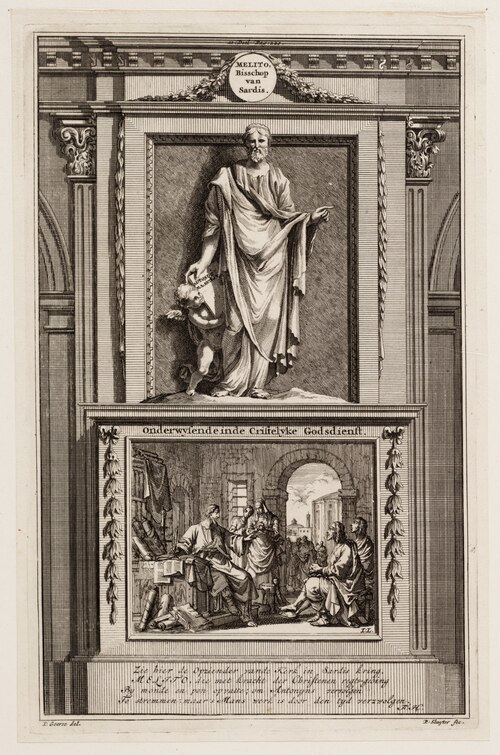
In this article, I will examine the source of Melito of Sardis’s canon list, preserved in Eusebius’s Ecclesiastical History, Book 4, Chapter 26. I hope to demonstrate the source of this list, because Melito is a vital witness for historians of early Christianity; his writings represent some of the earliest surviving evidence for the Christian scriptural canon. Nonetheless, much ink has been spilled debating the source and content of this list, so an examination is warranted.
Considering his works, it’s important to note that little of his writing remains, with only a few scattered references. A famous fragment from Eusebius in his work Ecclesiastical History references a six-book compilation by Melito known as the Extracts, and Eusebius quotes a portion of Melito’s own work directly. He begins by cataloguing Melito’s body of works [1], but notably absent is the Extracts; it is not until later that he writes the following:
“But in the Extracts made by him the same writer gives at the beginning of the introduction a catalogue of the acknowledged books of the Old Testament, which it is necessary to quote at this point. He writes as follows:
- Melito to his brother Onesimus, greeting: Since you have often, in your zeal for the word, expressed a wish to have extracts made from the Law and the Prophets concerning the Saviour and concerning our entire faith, and has also desired to have an accurate statement of the ancient book, as regards their number and their order, I have endeavored to perform the task, knowing your zeal for the faith, and your desire to gain information in regard to the word, and knowing that you, in your yearning after God, esteem these things above all else, struggling to attain eternal salvation.
- Accordingly when I went East and came to the place where these things were preached and done, I learned accurately the books of the Old Testament, and send them to you as written below. Their names are as follows: Of Moses, five books: Genesis, Exodus, Numbers, Leviticus, Deuteronomy; Jesus Nave, Judges, Ruth; of Kings, four books; of Chronicles, two; the Psalms of David, the Proverbs of Solomon, Wisdom also, Ecclesiastes, Song of Songs, Job; of Prophets, Isaiah, Jeremiah; of the twelve prophets, one book ; Daniel, Ezekiel, Esdras. From which also I have made the extracts, dividing them into six books. Such are the words of Melito.”(Ecclesiastical History, Book 4, Chapter 26 v. 12-16) [2]
As recorded by Eusebius, Melito begins his introduction on Extracts with a greeting addressed to Onesimus. He writes that Onesimus “expressed a wish to have extracts made from the Law and the Prophets concerning the Saviour and concerning our entire faith”. From this small excerpt available, it seems Onesimus, a brother or fellow Bishop, is requesting a work to be made from the Law and the Prophets[3], but for what purpose? Admittedly, this is not known, but what is to be noted is that Melito does say that he has made the extracts, dividing them into six books [4]. Since this work, “Extracts,” is lost to history, one can only speculate what the work’s purpose was and what the contents of this work included. Looking at the scholarship on the subject, I think there is a likelihood that this work was to be used for polemic purposes. It has been suggested that the list that Melito provides is simply the books of the Jewish canon, provided with messianic testimonies that would be useful in debates with Jews. [5] From Eusebius ‘ history, the purpose of “Extracts” seems to be clear: Onesimus has requested materials from the Law and the Prophets, and Melito has compiled them into 6 books. What is hard to say is what the use of the material was for. Onesimus was requesting this information to “gain information in regard to the word,” and it would seem probable that Melito compiled this list to instruct Onesimus or fellow Christians in the basics of the faith.
Phillip Schaff writes, “The nature of the work is clear from the words of Melito himself. It was a collection of testimonies to Christ and to Christianity, drawn from the Old Testament law and prophets. It must, therefore, have resembled closely such works as Cyprian’s Testimonia, and the Testimonia of Pseudo-Gregory, and other anti-Jewish works, in which the appeal was made to the Old Testament, the common ground accepted by both parties-for proof of the truth of Christianity.”(Nicene and Post-Nicene Fathers of the Christian Church, Second Series, Philip Schaff and Henry Wace, pg. 206 footnote 6).
Melito’s choice to draw exclusively from what is now identified as “Old Testament” sources (a label I use here only for convenience, and one I complicate below) is rather striking; it seems odd for Onesimus to only request this, rather than from apostolic writings, which by Melito’s time were already circulating and being cited as authoritative. Melito himself is at least familiar with the Gospel of John, as we see in his work On Pascha, a clear familiarity with Gospel material. His use of “I am” language in line 103 is eerily reminiscent of John 8, and earlier on in the work, in line 70, he writes “the one made flesh in a virgin, who was hanged on a tree, who was buried in the earth, who was raised from the dead, who was exalted to the heights of heaven.” Alistar Stewart-Sykes notes, “his emphasis on the exalted Christ is again surely reminiscent of the Johannine tradition, not simply of the visions in Revelation but of the exaltation tradition underlying John’s Gospel, where, throughout the farewell discourses Jesus talks of glorification without mentioning resurrection.” And for line 103 he writes “In this rhetorical climax we may see Melito functioning as a prophet by speaking the words of the present and risen Christ, speaking to his people in the assembly, present in his spirit as through the sacramental actions of the Pascha. The similarities with the “I am” sayings of the fourth Gospel are striking, and are not fortuitous, for they derive from a common practice of prophecy through the possession of the prophet by the spirit of Christ.” [6]
The restriction to “the Law and the Prophets” suggests something more specific than general Christian education. It has been suggested that Melito is delivering a specifically Christian list of authoritative books, ergo a list that he deems authoritative. Regardless of whether the list of books Melito delivers carries Christian or Jewish authority, the Extracts themselves, grouped, would amount to nothing more than scriptural excerpts demonstrating Christ and the Saviour, and such excerpts could plausibly serve either audience: instructing Christians in the basics of the faith, or arming them for polemics against Jewish interlocutors who accepted the same underlying Scripture.
Is Melito Providing a Jewish List or a Christian List?
Another question that must be asked is whether Melito intends to provide to Onesimus a Christian list or a Jewish one. This is important for consideration for a few reasons.
Melito could be providing Onesimus an authoritative Christian canon. This means his travel to the east would entail him meeting with a Christian source rather than a Jewish one. However, it seems odd that a bishop such as himself would not already know his own scriptures, and the evidence bears this assumption out. For example, On Pascha was written before, if not around the same time as, his letter to Onesimus [7] and in it Melito already demonstrates a clear familiarity with the “Law and the Prophets”. In On Pascha line 72, he writes: “Where is it written in the law and the prophets: ‘They repaid me bad things for good and childlessness for my soul. They planned wickedness for me saying, “Let us tie up the just man because he is a nuisance to us.”‘ Here, Melito is quoting from the Greek Septuagint’s Isaiah 3:10, which is comparatively distinct from the Hebrew version, and he does so authoritatively, using it polemically and dogmatically in his own Passover Homily. Add to this his evident familiarity with the New Testament, obvious from the Johannine echoes in On Pascha discussed earlier, and the picture is of a bishop already well-versed in his own community’s scriptural authorities. This makes it all the more odd if he is transcribing a Christian canon list to Onesimus: why would he already know and confidently deploy a Septuagintal text in his own theological work if that wasn’t the scriptural corpus he held to?
Also noteworthy, if Melito had received a Canon from the disciples, an agreed-upon first-century collection of “Scripture”, it is curious that he has to travel to Palestine to obtain this information. What does this demonstrate, if not that the early Christian canon was still fluid? [8] More plausibly, the trip was undertaken to verify or collect an external, comparative list, answering Onesimus’ request for an accurate count and order of “Old Testament” books, rather than to assemble scripture for his own congregation’s use.
If Melito intends to provide a Jewish list, he seems to do it rather well. When considering his contents, scholars can confidently say that Melito does not include Esther and leaves ambiguous what is contained in the book of Jeremiah (quite possibly the Wisdom of Solomon as well) [9]. The list does mirror the modern-day Tanak closely. With this in mind, the question must be asked as to why the trip to Palestine was necessary and why he couldn’t have consulted other Jewish companions in Sardis?
Considering this, ultimately I think Melito intends to provide a Jewish collection of scriptures for the purpose of polemics. Regardless of whether the underlying source is Christian or Jewish, the Extracts themselves would serve the same function; what is striking, however, is that both possibilities point to the same conclusion: the contents of both the Jewish and Christian canons were still in flux in Melito’s day. Precisely because those boundaries were unsettled, it is far more plausible that a bishop would need to travel in order to ascertain the contents of the Jewish canon than his own. As a bishop, Melito could presumably already be aware of which books his own community read as scripture; there would be little reason to journey to Palestine merely to confirm what he could have answered from his local church. A request for the Jewish canon, by contrast, is exactly the kind of question that would send him seeking a concrete, defensible answer “in the place where these things were preached and done” an answer he could then wield against Jewish interlocutors on their own terms. It therefore seems more likely that what Onesimus wanted, and what Melito went east to secure, was not a summary of Christian scripture but a firm grasp of the Jewish canon.
McDonald writes that agreement on the contents of Jewish Scripture is questionable, pointing to Melito of Sardis: despite living among one of the largest Jewish communities in the Greco-Roman world at the end of the second century CE, Melito had to travel to the East (likely Jerusalem) to determine which books belonged in the Old Testament. McDonald argues this trip only makes sense if there was no settled, universally known canon he could have confirmed locally; otherwise, he could simply have asked a Jewish neighbor.[10] John Barton too discusses this, noting that Melito travelled east to discover which ancient books the Jews there considered Scripture, because this was disputed among the Christians in his own community. [11]. Hahneman writes: “Confusion about the exact contents of the Jewish canon is evidenced by Christian writers as well. Melito (c. 170) provided a list of the books of the Jewish canon in answer to frequent questions from his brother [bishop?] Onesimus, who ‘desired to have an accurate statement of the ancient books as regards their number and order’ (Eusebius, HE 4.26.13–14). …Both lists that Melito and Origen presented are clearly Jewish catalogues and not Christian ones“. [12] Other scholars have noted that Melito’s claim to go to the east indicates his list was retrieved from Jewish sources [13].
What Does Melito Mean By “Old Testament/Covenant”?
Finally, one should consider what Melito meant by the term “Old Covenant”, the label used above as a convenience, but whose applicability to Melito’s own thought I take up directly here. As used in modern discussion, the phrase presupposes a fixed body of scripture standing opposite to an equally settled “New Covenant”, but it remains an open question whether Melito intended this meaning when he used the term. Recall the line from verse 14 of Eusebius’ 26th chapter of Book 4. Melito allegedly writes: “Accordingly when I went East and came to the place where these things were preached and done, I learned accurately the books of the Old Testament, and send them to you as written below.” (Note that in Greek, the words used for ‘covenant’ and ‘testament’ are the same word.)
The usage of the label “Old Covenant” here, has led some online advocates to assume Melito is handing Onesimus a distinctly Christian list, one that presupposes ‘Old Covenant’ and ‘New Covenant’ already functioned as the titles of two paired bodies of books in Melito’s day. This assumption, however, does not hold up. F.F Bruce writes in his work The Canon of Scripture: “Since Melito says that he ascertained the number and names of the books in Palestine, it may be that he derived them from a Jewish source. He is the first extant writer to describe them comprehensively as ‘the books of the old covenant’ (or Old Testament). This does not necessarily imply that he would have called the evangelic and apostolic writings ‘the books of the new covenant’ (or New Testament); this expression is first attested a decade or two later.“ [14] It would be anachronistic to expect early Christian authors to use terminology the same way modern readers do. It is more likely that Christians in the first century did not use this term to denote the books of the Bible. Ferguson shows a developmental arc of the term’s usage spanning from Melito to Origen. Ferguson writes, “Melito of Sardis, as his predecessors generally, did not employ the word ‘covenant’ in writings directed to the church.” [15]. Given how gradually the term “Covenant” developed into a fixed title for two bodies of scripture, a process not fully cemented until after Melito’s death, his use of the phrase “old covenant” cannot prove he was handing Onesimus a distinctly Christian canon. In the slightest sense, then, Melito’s use of the term cannot be pressed to mean he is strictly describing a Christian list of books. Onesimus is likely requesting, not a distinctly Christian collection of texts in the modern sense, but the Jewish scriptures themselves, the writings that witness to God’s covenant relationship with Israel under the old dispensation, independent of any settled pairing with a “New Covenant” that Christian usage would later impose. That is the books of the old covenant people, not a set of books.
It has also been suggested that Paul himself uses “Old Covenant” to designate the Old Testament in the modern, bibliographic sense. This is argued from 2 Corinthians 3:14, where Paul writes that “when they read the old covenant, that same veil remains unlifted, because only through Christ is it taken away.” This is not the case, however. Paul’s language here is theological, not bibliographic; he restates the same thought a verse later as “Moses is read” (v. 15), indicating that “Old Covenant” names the reading and proclamation of the Law itself, not a bounded set of scriptural books. The Pulpit Commentary and Ellicott’s Commentary for English Readers[16] both reach the same conclusion, the latter noting explicitly that the phrase carries “no allusion to the Old Testament as a book.” Read this way, Paul’s usage lends support to the reading of Melito proposed above: if the earliest Christian attestation of “Old Covenant” already carried this theological sense rather than a bibliographic one, then Melito’s application of the same phrase to a body of writings, writings tied to Israel’s covenant rather than to a fixed Christian canon, is not an isolated or idiosyncratic move on his part, but consistent with how the phrase had already been used a century before him.
In conclusion, considering Melito’s purpose for “Extracts” as a proof text for Christ, his prior familiarity with both the Septuagintal “Law and the Prophets” and Johannine material, and the anachronism of reading “Old Covenant” as presupposing a settled “new covenant” counterpart, tilt the argument toward Melito providing Onesimus a Jewish rather than Christian catalogue. This is, however, not a decisive case, and other scholars argue that both canons remained fluid enough that Melito’s language does not clearly presuppose either. Much depends on the Wisdom of Solomon: if it is merely an alternate title for Proverbs, the case for a Jewish source strengthens; if it refers to the actual deuterocanonical book, the case for a Christian list strengthens instead. On balance, I find the Jewish-list reading more persuasive, though I hold it cautiously given how contested and fragmentary the evidence remains.
Footnotes
[1] In Ecclesiastical History, Book 4, Chapter 26 v. Eusebius writes: “Of Melito, the two books On the Passover, and one On the Conduct of Life and the Prophets, the discourse On the Church, and one On the Lord’s Day, still further one On the Faith of Man, and one On his Creation, another also On the Obedience of Faith, and one On the Senses; besides these the work On the Soul and Body, and that On Baptism, and the one On Truth, and On the Creation and Generation of Christ; his discourse also On Prophecy, and that On Hospitality; still further, The Key, and the books On the Devil and the Apocalypse of John, and the work On the Corporeality of God, and finally the book addressed to Antoninus.”
[2] Ecclesiastical History, Book 4, Chapter 26 v. 12-16.
[3] Lee Martin McDonald explains how this phrase “Law and the Prophets” is used in ancient Christianity not to refer to the Torah and the Neviim but is an expression used to refer to all scripture. He notes that Jews in the first century acknowledged their scriptures and Law and Prophets even though some of those writings were later assigned to the Ketuvim. See, Pg 310 of Formation of the Biblical Canon Vol.1.
[4] This work is lost to history, but is also mentioned by Jerome in De Viris Illustribus Chapter 24. Jerome notes Melito’s works and includes “six books of Eclogues”.
[5] See The Biblical Canon Lists from Early Christianity, pg. 79, where Meade and Gallagher cite Kaestli’s assertion that Melito intends to list the books of the Jewish canon that could provide messianic testimonies useful in debates.
[6] See On Pascha with the Fragments of Melito and Other Material Related to the Quartodecimans by Alistar Sykes, pg. 56 fn. 29 and pg. 65 fn. 37.
[7] Meade and Gallagher date the Extracts to 170 CE, see pg. 79 of The Biblical Canon Lists from Early Christianity; Stewart-Sykes dates On Pascha to 160-170, see pg. 3.
[8] See McDonald, Formation of the Biblical Canon, Vol.1, pg. 370-371.
[9] “Melito leaves out Esther, doesn’t specify exactly what was contained in Jeremiah (in some Septuagint collections, Baruch, Lamentations, or the Letter of Jeremiah were included together), and probably includes the Wisdom of Solomon.16” (Tim Law, 268, fn. 16).
[10] See McDonald, Formation of the Biblical Canon, Vol.1, pg. 348-349.
[11] See John Barton, A History of the Bible, pg. 293.
[12] Hahneman, Geoffrey Mark, The Muratorian Fragment and the Development of the Canon, pg. 76-77.
[13] “However, we should not think of this as a Christian innovation, since Melito has stated that he got his list from Jewish sources.” Andrew Steinmann, The Oracles of God, page 257.
[14] F.F. Bruce, Canon of Scripture, pg. 71.
[15] Everett Ferguson, “The Covenant Idea in the Second Century,” pg. 150 and 151, in Texts and Testaments. The fluidity of the term persisted even after Melito. An anonymous anti-Montanist writer (ca. 192) offers the first attestation of “the word of the new covenant of the gospel” (Eusebius, HE V.xvi.3), yet his list of “New Covenant” prophets includes early 2nd century figures nowhere mentioned in the New Testament books, showing he had an era or dispensation in mind rather than a fixed collection of scripture. Likewise, though Irenaeus’ Against Heresies is the first surviving Christian document to construct a formal proof from Scripture using the New Testament as the Old Testament had previously been used, there is no clear indication he knew “New Covenant” as a collective designation for this body of writing. The paired, fixed usage familiar to modern readers does not appear clearly until Clement of Alexandria and, more explicitly still, Origen, a full generation or more after Melito.
[16] The Pulpit Commentary on 2 Corinthians 3:14 states: In the reading of the old testament; rather, the old covenant. There is no allusion to the Old Testament as a book, but the phrase is equivalent to “Moses is read” in the next verse. Ellicott’s Commentary for English Readers concurs, noting: The “Old Testament” is clearly used, not, as in the modern sense, for the whole volume of the Law–Prophets and Psalms–but specially for the law which was the basis of the covenant.

Pingback: The Contents of Melito's Canon List: A Closer Look At Wisdom of Solomon -